
Qualifying
We qualify on what disqualifies.
Day-one megawatts and the scale ceiling. kW per rack. Air, direct-to-chip or immersion. Redundancy tier. The four or five facts that cut the list from thirty to three.
Colocation, megawatts, density and cooling, matched against capacity that actually exists, on dates that actually hold. We do not own facilities, which is exactly why we can tell you which ones are wrong for you.
Send three numbers and we can be useful immediately: megawatts at day one, kilowatts per rack, and the date it has to be live. Above 40 kW per rack the shortlist of halls that can actually take you narrows fast, and we will say so rather than tour you through the rest.
Power is the gating constraint in this market and it is not getting looser. Everything else, space, term, price, carrier mix, is downstream of whether the energy is there and contracted.
What high-density space costs and where the shortlist collapses: colocation above 40 kW per rack, and the full build in what a 4,096-GPU cluster costs.
Day-one megawatts and the scale ceiling. kW per rack. Air, direct-to-chip or immersion. Redundancy tier. The four or five facts that cut the list from thirty to three.
Energised capacity, build-to-suit, powered shell and under-development are four products sold with the same vocabulary. We tell you which one you are being offered.
Carrier neutrality and who is on-net. Cross-connects. Cloud on-ramps. Dark fibre and subsea adjacency. Metro precision, not a region label.
In constrained markets, contract length is often what gets you in the door. We show you where flexing the term opens capacity that price alone will not.
If the space is the problem today, one of these is usually the problem next:
Every AI facility conversation reduces to one question: where do the megawatts come from, and when. Grid connections are quoted in years in most markets, which means real available power is the scarcest asset in the chain, scarcer than the GPUs. A brochure that says a site supports AI densities and a substation agreement that guarantees the draw are different documents, and we qualify on the second.
The checklist we run before a site is proposed: secured power and its escalation terms, rack density the floor actually supports today, cooling that matches the generation you are deploying rather than the one the hall was built for, carrier diversity, and expansion rights in writing. A site that fails any one of these will fail it at the worst possible time, which is after your hardware has landed.
For operators with stranded capacity, the desk runs in reverse: we match your watts against qualified demand, from single-hall requirements to multi-megawatt anchor tenants.
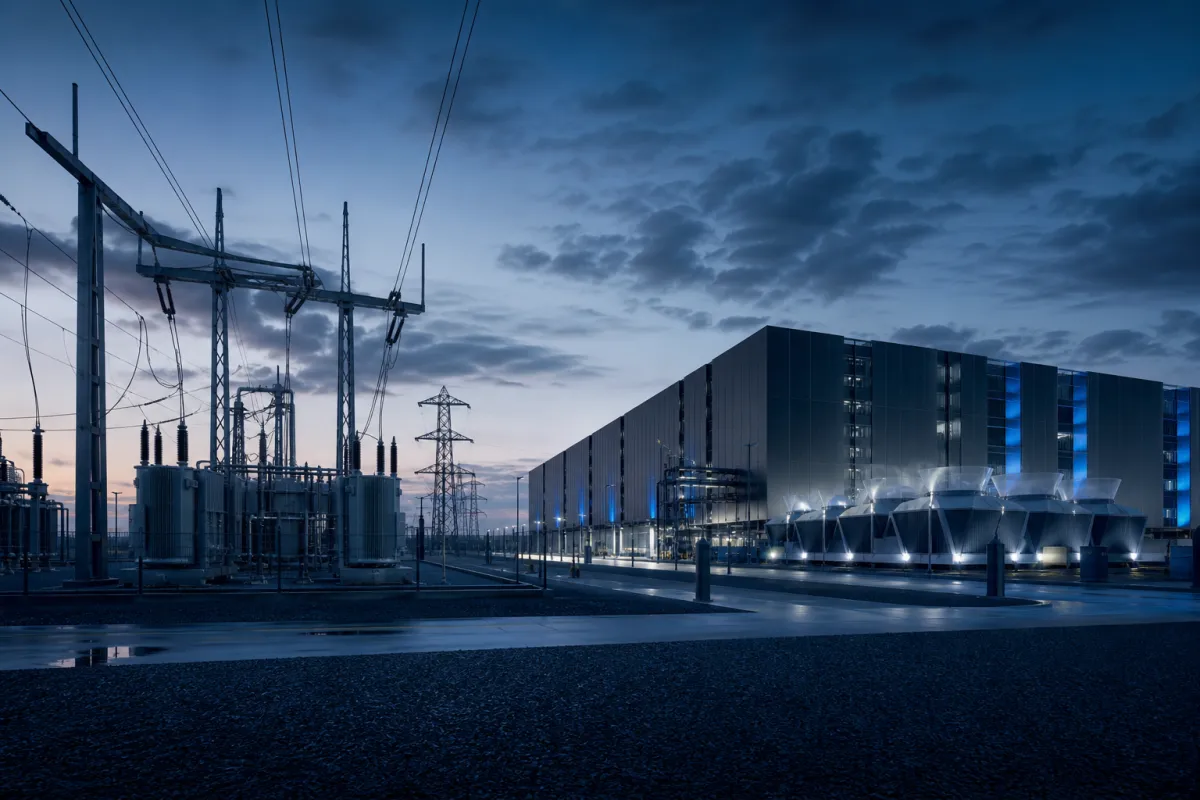
Settle density first and the market narrows honestly. Skip it and you tour halls that were never going to work.
Density decides the shortlist long before price does
Rack-scale AI is now measured in tens of kilowatts per rack, and the newest generations push past what most legacy halls can cool. As a sanity check: a modest fifty-node deployment is a megawatt-class conversation once cooling overhead is counted. This is why we qualify power before anything else.
The generation decides, not preference. Current flagship HGX platforms are increasingly liquid-first, and a hall without liquid capability restricts you to lower-density configurations. If your roadmap includes the next generation, the cooling question is really a which-buildings-qualify question.
Usually, and the honest answer depends on the country and the timeline. Named facilities with real available power exist in fewer places than the market maps suggest. Tell us the jurisdiction constraint and we will tell you what genuinely exists there.
Yes. Qualified demand for real available power is the easiest match we make. We verify what your site can actually deliver, then put it in front of buyers whose requirements it fits, on your commercial terms.
Operators compensate us under referral agreements for qualified volume. You pay nothing incremental. We have no floor to fill and no position in your deal, which is the only reason our shortlist is worth anything.
Megawatts, density, cooling, metro, ready-for-service date. Bring the constraints, not the brief.
With the operators who can genuinely serve it, and an honest read on the ones who mean eventually.
We introduce and step back. No cost at any point.
A desk that never declines anything is selling something. Ours is not. Stated up front, so nobody spends a week finding out.
Whoever's workload occupies the capacity and whose balance sheet stands behind the term, or an advisor they name in writing.
You contract directly with the OEM, ODM, distributor, cloud or facility. We are not in the chain and we do not add one.
Run first, not after the commercial terms. It is why suppliers quote our buyers real numbers instead of screening quotes.
Brokers and resellers without a nameable end user do not get a file. If a requirement is wrong for the desk, we say so in the first reply.
Twenty minutes with the desk, no pitch and no quote at the end of it. Tell us roughly what you need and we will come back within one business day.
Your enquiry has landed with the desk. Acknowledged within one hour.