
GPU capacity in Singapore.
Singapore is Southeast Asia's connectivity anchor and the most deliberately rationed data centre market in the region. Capacity here is awarded against efficiency criteria, not simply built.
What decides a deployment in this metro.
Why buyers come here, and what they run into.
Singapore's subsea and carrier density make it the natural front door to Southeast Asia, and for latency-sensitive regional serving there is no close substitute. That advantage is why buyers keep paying the premium.
Capacity, though, is deliberately scarce. After a period of paused development, growth now runs under a sustainability-led framework allocating capacity against efficiency criteria. Operators holding capacity choose their tenants, which means arriving with a clean, credible requirement matters more here than almost anywhere.
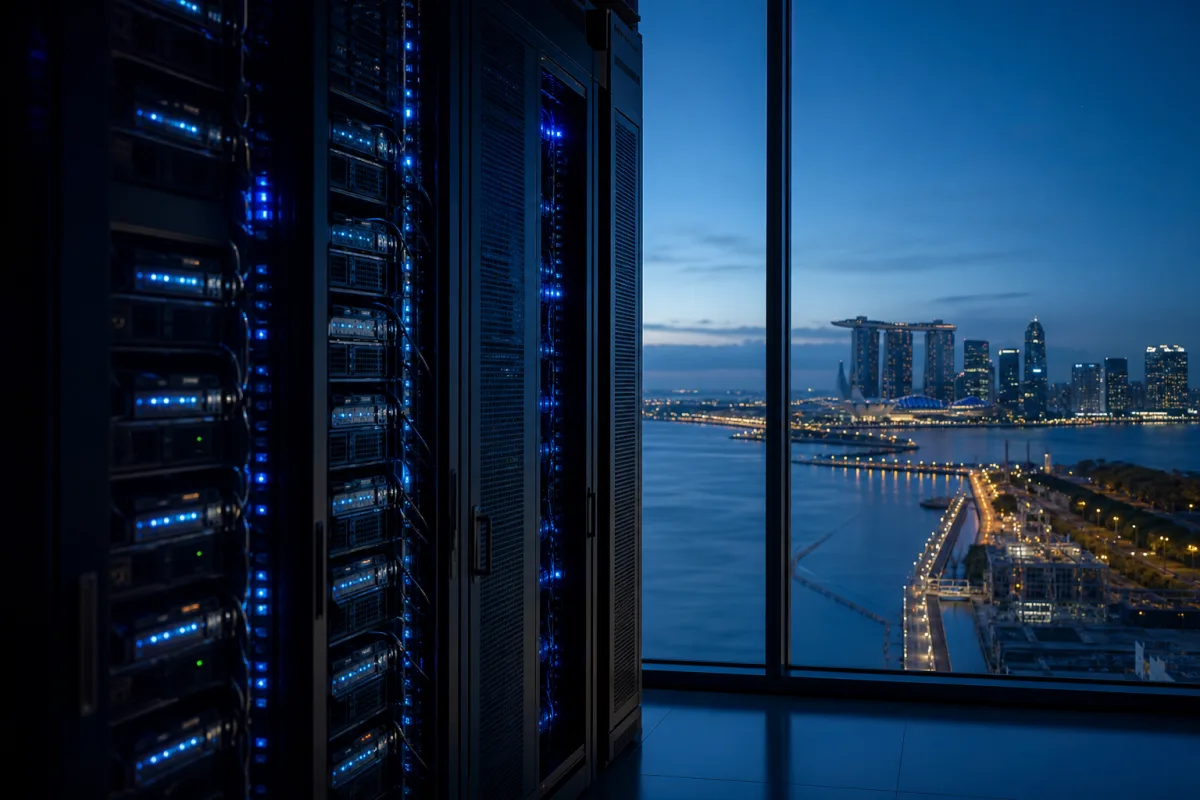
The design that actually works.
The strategy that works: anchor the latency-critical inference layer in Singapore and place sustained training in nearby markets with better availability and power economics, connected privately.
That is not a downgrade. It usually delivers more compute for the same spend while preserving the latency that made Singapore attractive. Wider context is on the Singapore desk and the APAC desk.
Start from what is verified.
Current verified lines with quantities, lead times and indicative pricing are public on the live inventory. Anything not listed becomes a sourcing requirement with a first pass inside one business day.
Colocation in Singapore, through the same desk.
The desk sources colocation, racks and power in this metro as well as the compute that fills them. Singapore is allocation-constrained by policy, so real capacity questions route through Johor as often as the island itself. Requirements come to us as three numbers: megawatts at day one, kilowatts per rack, and the date. The space and power desk takes it from there, and above 40 kW per rack we will tell you honestly how short the local shortlist is.
Asked first, answered straight.
Yes. Space, power and cooling in this metro route through the same desk as the compute, priced against your density and date. Above 40 kW per rack the local shortlist narrows quickly, and we say so rather than tour you through halls that cannot take the load.
For the right requirement, sometimes, and we will say so plainly when the answer is no. Capacity is allocated rather than advertised, so the credibility of the requirement matters.
Land and power are genuinely constrained, and national policy allocates new capacity against sustainability and efficiency criteria rather than allowing unrestricted development.
Nearby regional markets connected privately back to Singapore for the latency-sensitive layer. Most serious Southeast Asian deployments now run this way.
For GST-registered businesses, generally yes, provided the entry paperwork is correct. We structure it so it is a timing question rather than a cost.
Working through this on a real requirement?
Twenty minutes with the desk, no pitch and no quote at the end of it. Tell us roughly what you need and we will come back within one business day.
Sent. We are on it.
Your enquiry has landed with the desk. Acknowledged within one hour.