The queue does not care about money
What the queue looks like
- Lead times for high-end data-centre GPUs have stretched to six months or longer during peak demand, which is precisely when allocation discipline decides who gets served.Source: GPU supply chain analysis, ausjournal.com, 2026
- Australia is treated as a favourable destination under US advanced-chip export policy as an AUKUS partner, which is why destination, not budget, moves hardware.Source: Gilbert + Tobin, AI infrastructure and financing, 2026
- Verified lines currently clear in 7 to 25 days for buyers whose compliance file is already complete.Source: SSP verified inventory, August 2026
In a normal market, the biggest cheque wins. The GPU market is not a normal market. Supply is constrained, every serious SKU is spoken for before it exists, and suppliers choose who to sell to. The choosing is the whole game.
What suppliers optimise for is not price, because at current demand everyone pays the price. They optimise for risk: the risk a shipment gets held at export, the risk hardware surfaces somewhere it should never have gone, the risk a buyer's paperwork collapses a compliance audit eighteen months later. One bad end user can cost a supplier their own allocation. So the question they actually ask is not "how much will you pay?" but "where exactly is this going, and can you prove it?"
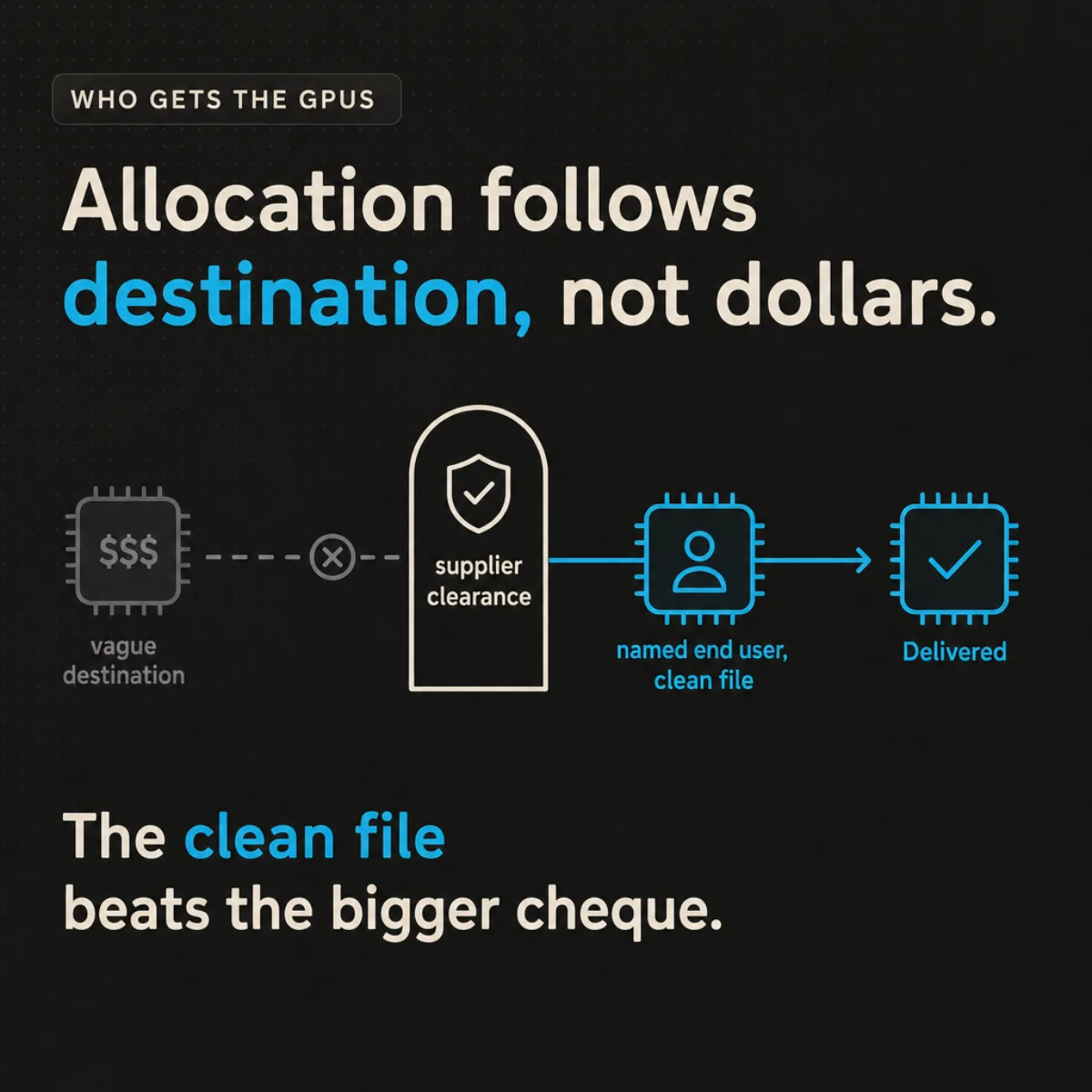
Allocation follows destination
This is the rule I wish every buyer knew before their first call: allocation follows the destination file, not the dollar figure. A buyer with a named end user, a named facility, a clean corporate structure and export paperwork in order is a low-risk sale, and low-risk sales get stock. A buyer with a big number and vague answers is a held shipment waiting to happen, and suppliers can smell it.
I have watched exactly this play out: two buyers after the same block of nodes, one offering more money with an opaque structure, one offering the market price with a complete file. The file won, and it was not close. The supplier never said why. They never do.
In a constrained market the clean file beats the bigger cheque. Prepare the destination before you chase the hardware.
What a clean file looks like
- A named end user. The entity that will actually operate the hardware, not a chain of intermediaries obscuring it.
- A named destination. The facility and jurisdiction, verifiable, with residency and export treatment already thought through.
- KYC that survives scrutiny. Corporate structure, beneficial ownership, sanctions screening: boring, decisive.
- A track record of not cutting corners. Suppliers remember. So do the agencies that oversee them.
The practical consequence
If your compute plans matter, build the file before you need it. The buyers who move fastest in this market are not the ones who shop hardest; they are the ones who arrive already verifiable. It is the least glamorous advantage in AI infrastructure, and the most reliable one I know.
Building the file before you need it
The practical playbook is short and boring, which is why so few buyers run it. Incorporate cleanly and be ready to show beneficial ownership without a fortnight of scrambling. Name the operating entity and the facility before you shop, even provisionally; a destination you can describe beats a destination you are still deciding. Collect the documents once, properly: corporate registration, ownership chain, the end-use statement, the facility relationship. Keep them current the way you keep insurance current.
Then, when hardware appears, you move in days while other buyers assemble paperwork in weeks. In a market where allocation windows open and close fast, that speed is not administrative tidiness. It is the whole advantage: verified buyers get the call first, and they get it again next time, because the supplier remembers who cleared without drama.
One more thing worth saying plainly: if any part of your structure exists to obscure who is actually taking delivery, fix that before you enter this market. The screening will find it, the deal will die late instead of early, and your name will be attached to the death. The clean version costs less in every currency that matters.