
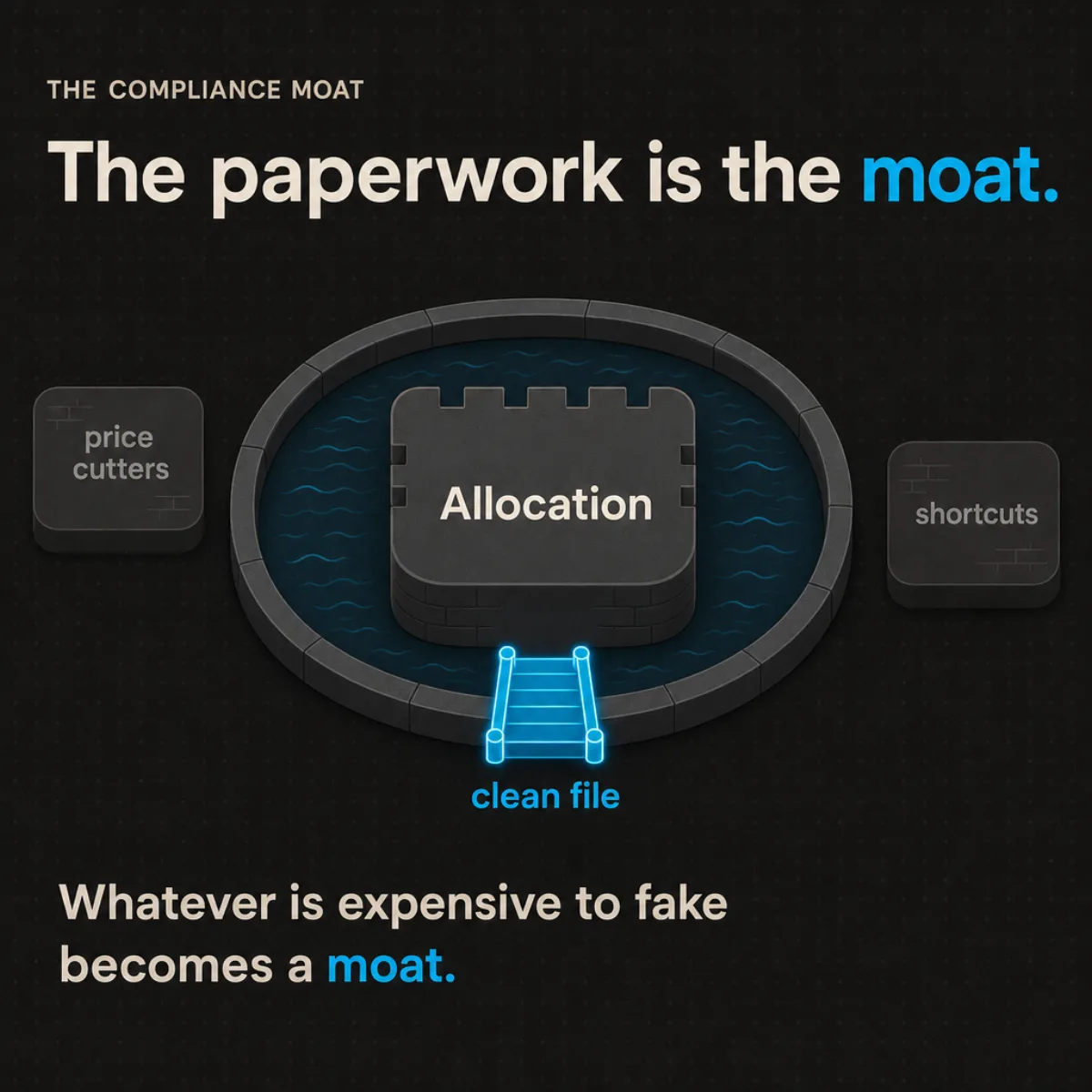
Clearance is the customs of this market
Advanced GPUs are controlled goods. Between a supplier and a buyer sits a wall of rules: export licensing, end-user verification, sanctions screening, re-export conditions. Most market commentary treats this as friction slowing an otherwise free market.
Look at it from the supplier's chair and it inverts. The rules are not slowing their market; the rules define who they can safely serve. Every tier-1 channel runs the same calculation: the value of one sale versus the risk that one bad shipment brings regulators into their allocation. Which is why the largest suppliers move nothing, at any price, without a complete file.
Friction for some is a moat for others
Here is the part that took me time to see clearly: whatever is expensive to fake becomes a moat for whoever does it properly. Anyone can claim allocation. Anyone can undercut on a quote. What cannot be faked quickly is a history of clean files, cleared shipments and end users who checked out, because that history lives in supplier records, not in marketing.
A desk with that history gets calls a price-cutting desk never gets: the quiet ones, where a supplier has stock to move and wants it moved safely. That is what "holding allocation" actually means. It is not a warehouse; it is trust with a paper trail.
Compliance is not the cost of doing business in GPUs. Done properly, it is the reason you get to do the business at all.
What this means for buyers
- Judge a desk by its screening, not its confidence. A desk that asks you hard questions early about end use and destination is showing you why its allocation exists. A desk that promises everything without asking anything is showing you something too.
- Run your file early, not last. Screening done at the start costs days. Screening discovered at shipping costs months, and sometimes the deal.
- Disclosure is protective. The buyers who disclose everything up front clear fastest. The instinct to hold information back reads, to every serious counterparty, as risk.
The uncomfortable version
There is a corner of this market that treats the rules as an obstacle course. Some of them make money for a while. All of them are one held container away from becoming a cautionary tale, and their buyers go down with them. The boring path is the durable one, and in this market boring compounds.
What running it properly looks like
Concretely, the discipline is a sequence, and the sequence is the product. Screening runs first, before commercial terms are discussed: end user, destination, ownership chain, sanctions exposure, re-export risk. Questions get asked once, documented properly, and the file is built to be shown, because a file you would hesitate to show a regulator is not a file, it is a liability with a folder name.
The second half of the discipline is the willingness to stop. Every serious desk eventually meets a deal that almost clears: the destination that is probably fine, the structure with one opaque layer, the counterparty who is offended by the questions. The margin on saying yes is visible and immediate. The cost of saying yes arrives later, compounds, and lands on everyone in the chain. Walking away from those deals is not lost revenue; it is the premium on the only insurance policy this market sells.
For buyers, the test writes itself: watch what a desk does when your own deal has a wrinkle. The ones who name the problem early and tell you what fixing it requires are the ones whose other deals are clean too. The ones who wave it through are showing you their standards, and you are not the only deal those standards touch.