
Why long terms price so well
The numbers behind the term
- Reserved and committed pricing undercuts on-demand by multiples at steady utilisation, which is exactly why vendors push longer terms: on-demand H100 sits around $1.49 to $3.50 per GPU-hour while reserved multi-year rates are negotiated well below it.Source: GetDeploying GPU Price Index, 2026
- Global H100 lead times have run beyond 20 weeks at points in the cycle, which is what makes buyers sign longer than the workload justifies.Source: Australian GPU procurement market commentary, ausjournal.com, 2026
- Current verified stock moves in 7 to 25 days, so scarcity is no longer the reason to over-commit on term.Source: SSP verified inventory, August 2026
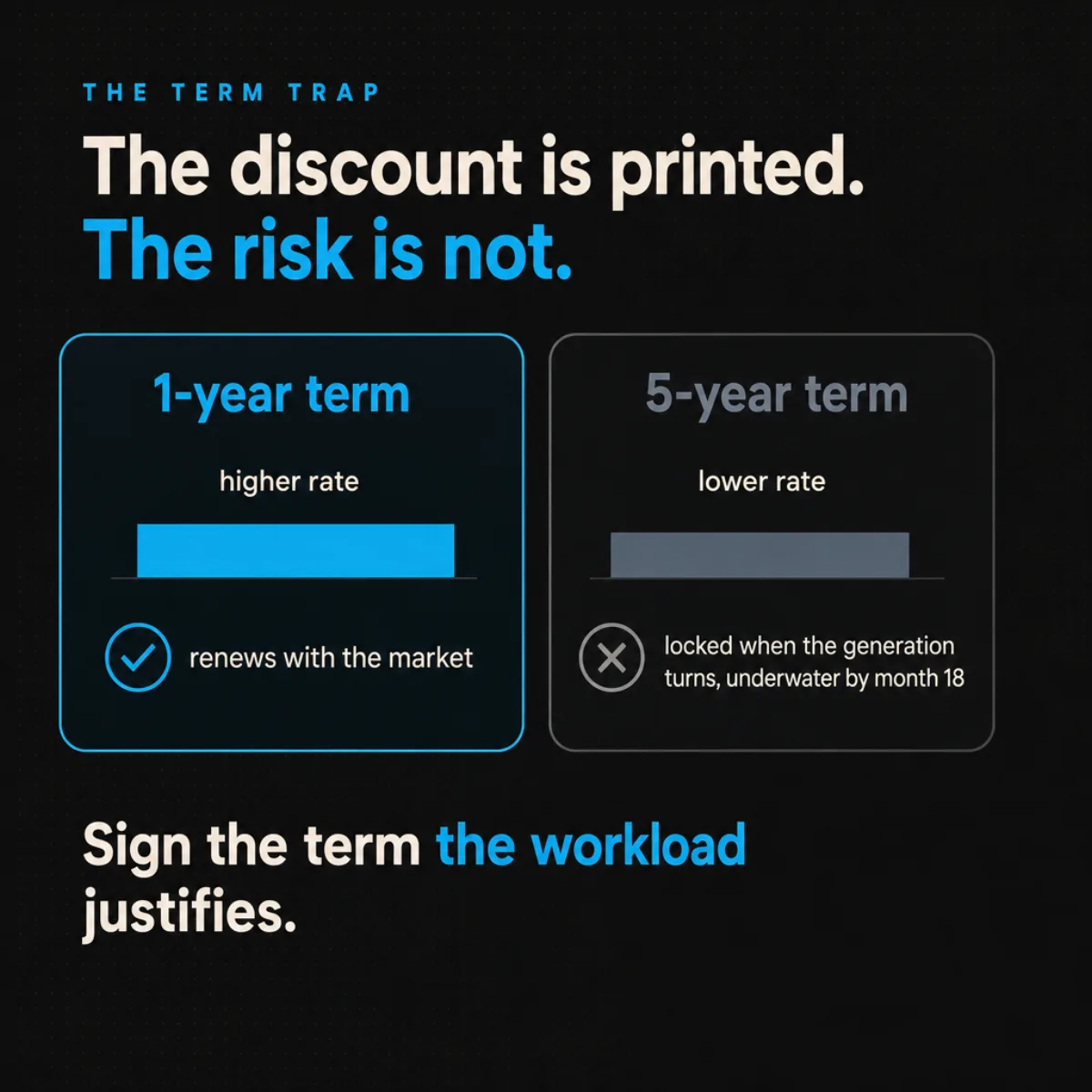
When a supplier offers you a sharply better rate for a five-year commitment, they are not being generous. They are selling you their risk.
A GPU generation turns over roughly every couple of years, and each new generation resets the market: yesterday's flagship reprices, and capacity built on it reprices with it. Whoever is holding committed capacity when that happens absorbs the fall. A supplier with your name on five-year take-or-pay paper has moved that entire problem onto your side of the table, and the discount is what they paid you to take it.
Sometimes that trade is worth it. The trap is that the discount is printed on the quote in large figures, and the risk is printed nowhere at all.
A tale of two terms
Picture the same cluster quoted two ways. The three-year term is meaningfully cheaper per hour than the one-year. On the spreadsheet, the three-year wins comfortably.
Now run the scenario the spreadsheet does not contain: eighteen months in, the next generation ships, and the market rate for your class of compute drops. On the one-year deal you renewed at the new market price six months ago. On the three-year deal you are paying the old price for another eighteen months, and the gap between what you pay and what the market pays eats the entire discount that made you sign, and then keeps eating.
Neither outcome is guaranteed. That is the point: the long term is not a discount, it is a position on where GPU pricing goes next. You are allowed to take that position. You should at least know you are taking it.
Sign the term the workload justifies, not the term that prices best. The discount is visible; the generation risk is not; both are real.
Where the real floor sits
So how do I actually advise buyers to term a deal? Three rules I keep coming back to:
- Term to the visible roadmap. If you can see eighteen months of funded workload, eighteen to twenty-four months of term is defensible. Terming to hope is how teams end up underwater.
- Price the exit at the entry. Renewal terms, extension options and what happens at expiry are all negotiable when you sign and nearly worthless to negotiate later. The cheapest insurance in the market is an exit clause priced while the supplier still wants your signature.
- Make the supplier hold some generation risk. A refresh option partway through a longer term, or a rate review pegged to the generation change, splits the risk instead of dumping it on you. Suppliers with real capacity will structure this. Suppliers who refuse are telling you what the long term was really for.
The question to ask before signing anything
Whoever is across the table, ask them one thing: what happens to this rate when the next generation ships? A good counterparty has an answer, because they have thought about it. A margin-taker changes the subject, because the answer is the deal.