
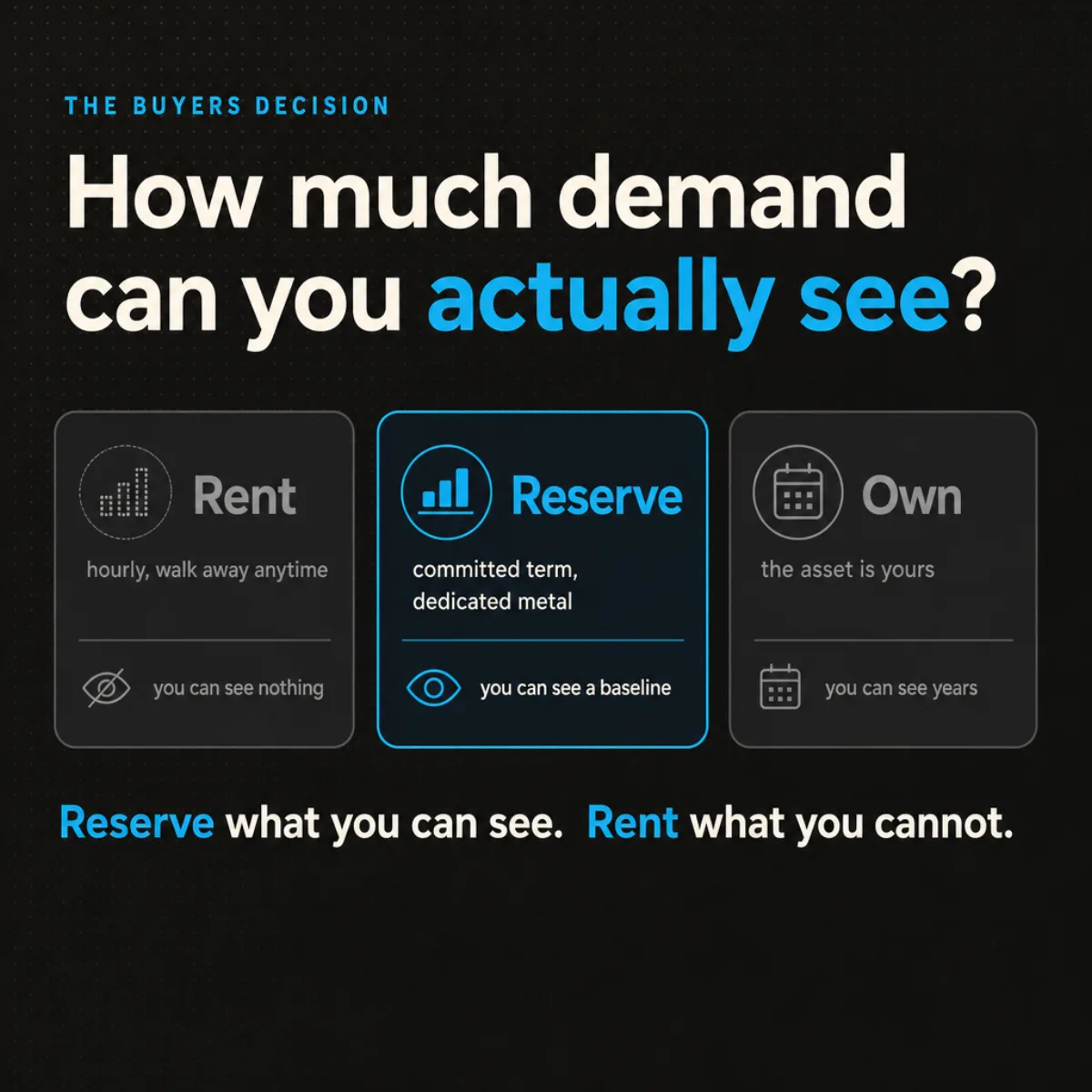
The three doors
What the market actually charges
- Renting an H100 SXM on a specialist GPU cloud runs roughly $1.49 to $3.50 per GPU per hour on demand, with H200 starting near $3.72 and B200 between $2.12 and $6.04 depending on tier and commitment.Source: GPU rental market survey, GetDeploying GPU Price Index and provider pricing pages, 2026
- Hyperscalers charge around 86% more than dedicated GPU clouds for the same H100 silicon.Source: Compute Exchange, Best GPU Rental Platforms 2026
- Owned H100 nodes in the current secondary market sit near $240,000 for an 8-GPU node, which is where the rent-versus-own arithmetic starts to bite at sustained utilisation.Source: SSP verified inventory, August 2026
Renting is on-demand cloud: pay by the hour, walk away whenever. Reserving is committed capacity: a defined rate for a defined term on dedicated hardware, usually bare metal in a named facility. Owning is exactly what it sounds like: the nodes are yours, along with everything that comes with them.
None of these is wrong. Each one is wrong for somebody, and the market is very good at putting each door in front of the wrong buyer. Cloud providers sell flexibility to teams with none of the variability that justifies it. Hardware channels sell ownership to teams who have never racked a server. And plenty of desks will sign you to a five-year reserve because the commission is better on long paper.
The question that actually decides it
Strip everything else away and the decision comes down to one thing: how much of your compute demand can you see, and for how long?
Not how much compute you want. How much you can see. A training roadmap with funded projects across the next two quarters is visible demand. A hunch that usage will grow is not. The three doors map onto three levels of visibility:
- You can see almost nothing. You are experimenting, evaluating, or demand genuinely spikes and vanishes. Rent. The on-demand premium is real, but you are actually using the flexibility it buys. This is the only situation where on-demand is cheap.
- You can see a baseline. There is a floor of usage that simply does not go away: the training queue is never empty, the inference traffic never drops below a level. Reserve that floor. At sustained utilisation, on-demand rates run multiples of a reserved rate for identical silicon, and every month you leave the baseline on hourly pricing you are paying that multiple for flexibility you never use.
- You can see years, and the workload runs hard. High utilisation, long horizon, a team that can operate hardware or a partner who will. Now owning starts to win, because you stop paying anyone else's structure at all.
Match the commitment to the visibility, not to the ambition. Reserve what you can see, rent what you cannot, and only own what you can see for years.
Where teams actually get it wrong
In practice I see the same two mistakes over and over.
The first is staying on rent too long. The workload became a baseline eighteen months ago, but migration feels like a project, so the team stays put and the cloud bill quietly becomes the largest line in the budget. Here is the uncomfortable arithmetic: if your utilisation is sustained, the two quarters you spend deciding typically cost more than the entire move.
The second is owning for the wrong reasons. Ownership appeals to instinct: an asset, control, no landlord. But the asset depreciates on NVIDIA's release schedule rather than yours, and the control comes bundled with import, deployment, operations, spares and an end-of-life problem. Owning is the right answer for a specific buyer, and an expensive identity statement for everyone else.
The blend nobody sells you
The answer for most serious teams is not one door. It is a blend: the visible baseline on reserved capacity at reserved pricing, the genuinely unpredictable layer on-demand, and ownership only where the numbers survive a spreadsheet built by someone with no stake in the outcome.
Nobody sells the blend, because nobody makes money on the whole of it. Which is precisely why it tends to be right.