
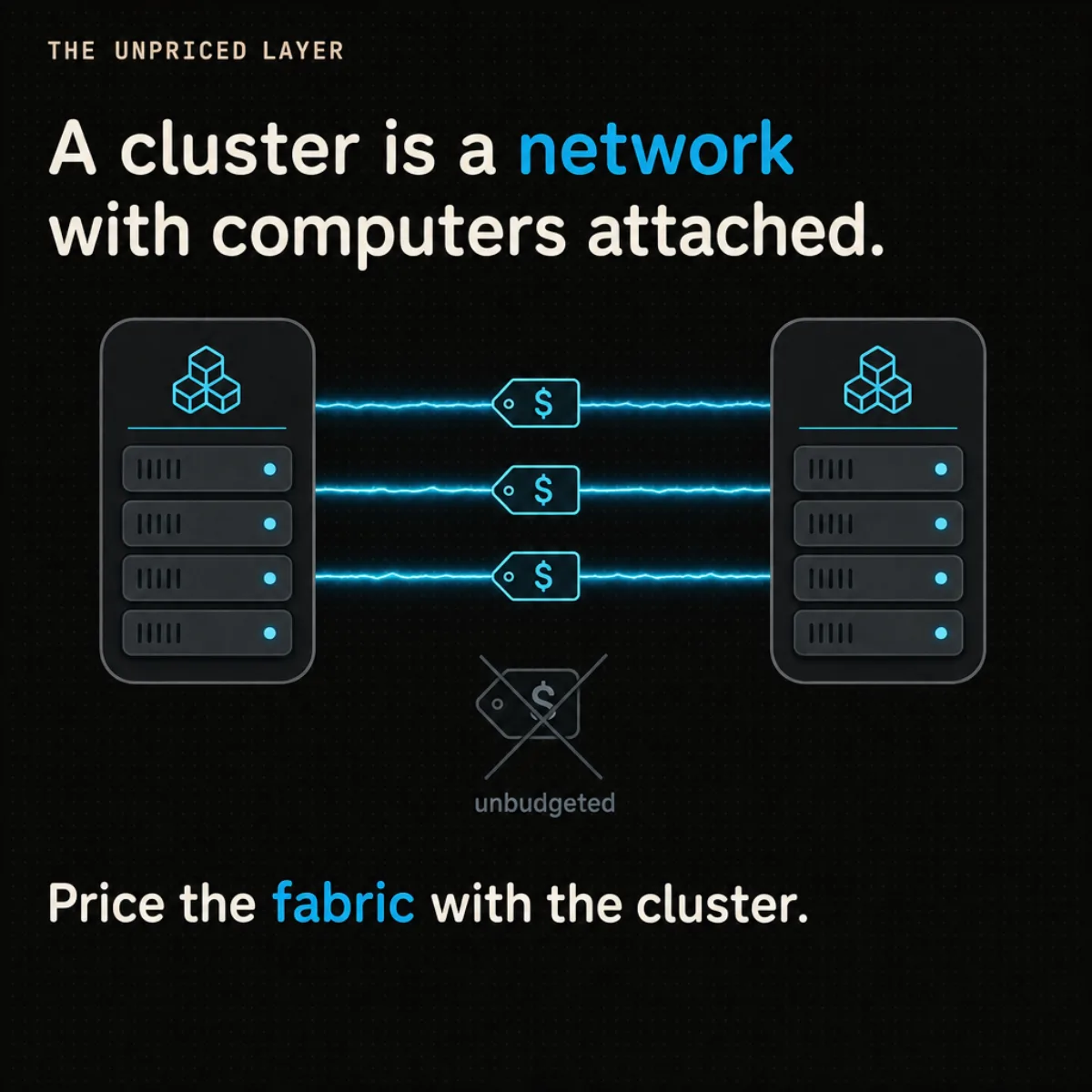
A cluster is a network with computers attached
Distributed training is a conversation between nodes, and the conversation runs over a fabric: switches, network cards, and a forest of transceivers and cables connecting all of it. Get the fabric wrong and fifty expensive nodes behave like fifty separate computers, which is a remarkable way to waste a cluster.
Yet in budget after budget, the network appears as a single hopeful line, if it appears at all. The GPUs got weeks of negotiation. The layer that makes them a cluster got an estimate.
Where the money hides
Two places. The first is quantity: a serious multi-node fabric consumes optics by the hundreds. Counting ports across a real topology produces numbers that startle first-time builders, and each of those ports needs a transceiver at each end and a cable between.
The second is the markup. Identical-spec transceivers vary in price several-fold depending on the channel they come through, and OEM list pricing on optics is one of the steepest markups in the entire industry. It survives because optics are bought late, in a hurry, by people who just want the cluster to work. Late, hurried and captive is the worst possible negotiating position, and the channel knows it.
Price the fabric with the cluster, not after it. Optics bought early and buyer-side are one of the easiest large savings in an AI build.
The questions to ask per layer
- Fabric choice: InfiniBand or high-speed Ethernet? Training at scale still leans InfiniBand; modern Ethernet closes the gap for many workloads at better economics. The answer is your workload's, not the vendor's.
- Topology: what does the job actually need? Over-built fabrics burn money; under-built ones burn GPU hours, which cost more.
- Optics sourcing: verified compatible third-party where support terms allow, OEM where they genuinely do not. Knowing which is which is worth real money.
- Between sites: if the workload spans locations, the interconnect between buildings is its own discipline with its own lead times. Plan it with the cluster.
The simple discipline
None of this is exotic. It is one sheet, priced early: every port, every transceiver, every cable, every link between sites, alongside the nodes they serve. The teams that do it save enough on the network to notice. The teams that do not, fund the markup.
What the sheet looks like
The fix costs one page. List the nodes, the ports per node, the switch layer, and count honestly: every port, transceiver and cable in the topology, plus spares, because optics fail and a cluster waiting on a transceiver shipment is burning GPU-hours to save pocket change. Price that list two ways: through the OEM channel, and through verified compatible third-party where support terms allow it. The gap between those two columns is usually the moment a team starts taking the network seriously.
Timing matters as much as sourcing. Optics have their own lead times, and a fabric ordered after the nodes arrive is a cluster standing idle in its most expensive month. Order the network with the compute, stage the delivery so the fabric is ready when the first rack lands, and commissioning stops being the phase where projects go quiet and schedules die.
None of this requires heroics. It requires refusing to treat the network as a detail, for one afternoon, early. The market charges an extraordinary price for skipping that afternoon, and it charges it in the two currencies that hurt most: money and time on the critical path.