
Why this is hard to judge from the outside
The GPU market rewards confidence. Supply is constrained, pricing is unpublished, and buyers rarely have a second data point, so a desk that speaks fluently and quotes quickly looks identical to a desk that can actually deliver. The difference only shows up at the seams: when a lead time moves, when export screening bites, when the quote meets the border. By then you are committed.
So you test for the seams up front. Five questions do most of the work.
The five questions
1. Where exactly does your allocation come from?
You are not asking for supplier names on a first call; you are listening for whether an answer exists. A real desk talks about verified holders, the authorized channel and named conditions. A box-flipper talks about their network. If the stock cannot be described, it cannot be delivered.
2. Who pays you, and how much of it sits inside my price?
Every desk gets paid; the only question is the geometry. If the margin lives inside your number, every conversation you have with that desk is a negotiation, including the ones that sound like advice. If compensation comes from the supply side and is disclosed, the desk can afford to tell you a SKU is wrong for you. Ask the question bluntly and watch the comfort level of the answer.
3. What happens with export controls and KYC on my deal?
This is the sharpest filter in the market. A serious desk runs screening first and can tell you exactly what your file needs, because clean compliance is why their allocation exists at all. A desk that waves the question away is describing shipments that get held, and possibly worse. In this market, the paperwork is the moat.
4. Quote me the landed cost, not the unit price.
Freight at node weights, insurance, duties, import VAT and its recovery, importer-of-record if you need one. A desk that can put all of that on one sheet has landed hardware before. A desk that quotes ex-works and calls the rest details has not, and the details will be your problem.
5. Tell me about a deal you walked away from.
My favourite question, because it cannot be prepared for. Every real desk has refused a destination that would not clear, a counterparty that failed diligence, a structure designed to blur the end user. If there is no story, either the desk is new or nothing has ever been refused. Both answers tell you what you need.
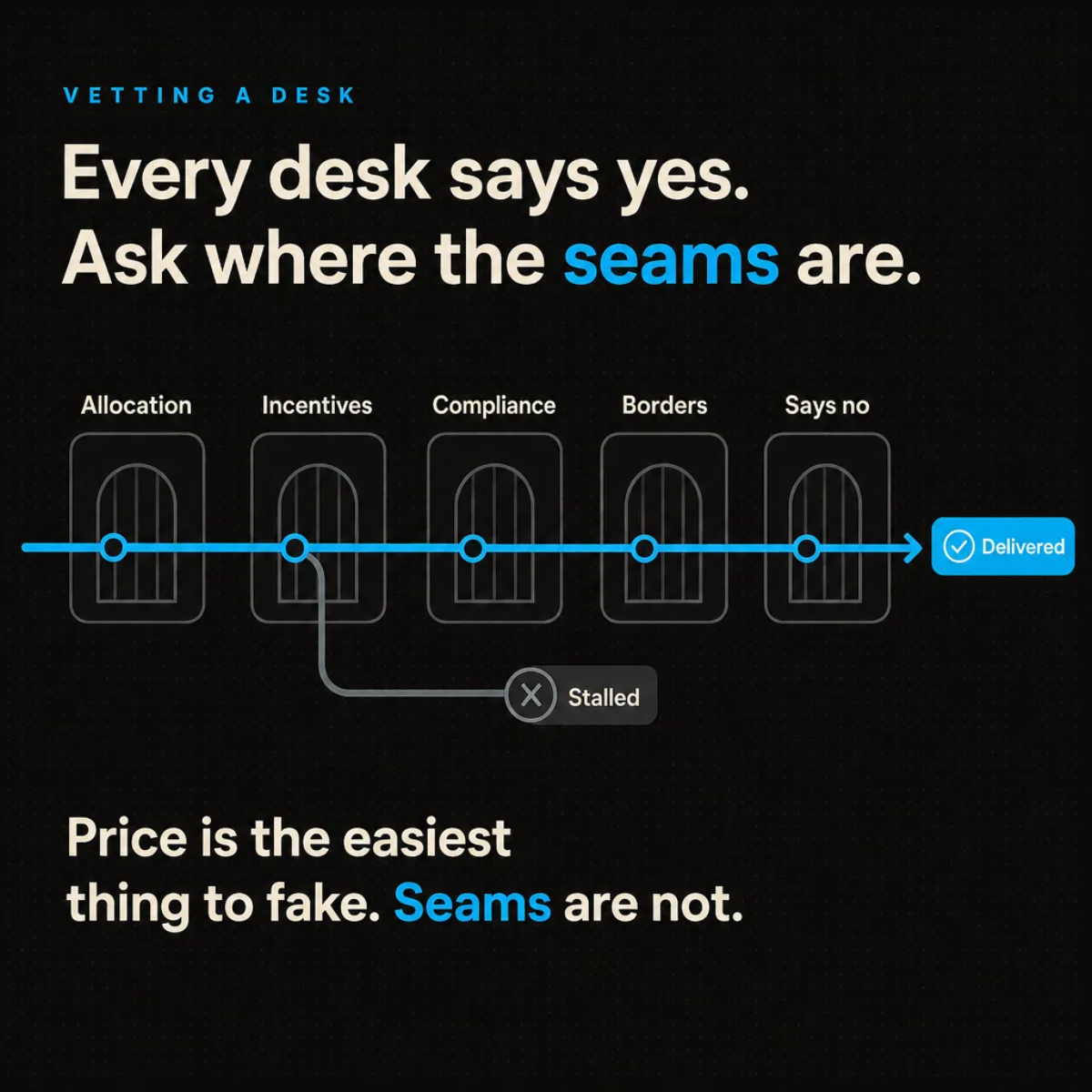
You are not vetting charm or speed. You are vetting what happens at the seams: allocation, incentives, compliance, borders and the willingness to say no.
The pattern behind the questions
Notice that none of the five is about price. In a market this constrained, price is the easiest thing to fake and the last thing to trust: anyone can write a low number on a quote for stock they do not hold.
Projects break at the seams between parties: between the quote and the allocation, the allocation and the border, the border and the rack. The desks worth working with are the ones who own the seams. That is the entire test.