
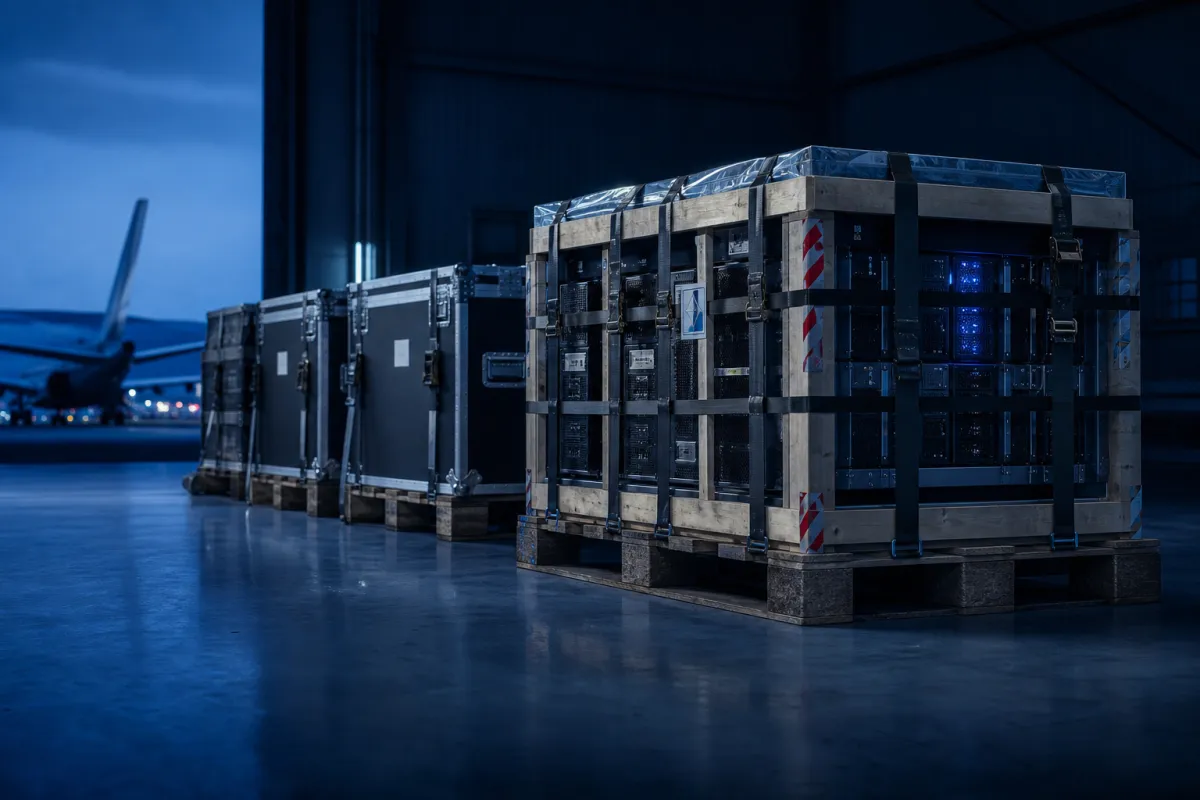
2027 isn’t here yet. Your AI infrastructure strategy should be.
The AI infrastructure market is entering another period of significant change. NVIDIA’s next-generation platforms are moving into production. AI workloads are becoming more demanding. Data center power requirements are increasing, and the infrastructure needed to support large-scale compute deployments is becoming more complex.
For enterprise buyers, the question is no longer simply which GPU to purchase. It’s which infrastructure decisions made today will still make sense in 2027.
At Strategic Supply Partners (SSP), we work across NVIDIA GPU procurement, dedicated compute capacity, data center colocation, power, connectivity, and infrastructure sourcing. Looking ahead, we see seven developments that deserve a place in every serious AI infrastructure procurement strategy.
1. NVIDIA’s Rubin Generation Will Reshape GPU Procurement Decisions
The next chapter of NVIDIA’s data center roadmap is already underway. Following the Hopper and Blackwell generations, NVIDIA’s Vera Rubin platform introduces a more integrated approach to large-scale AI computing. Rather than treating accelerators as isolated components, Rubin brings GPUs, CPUs, high-speed interconnects, networking, and supporting infrastructure together in rack-scale and larger system architectures.
NVIDIA announced in 2026 that Vera Rubin had entered full production, with deployments beginning across major cloud providers and infrastructure partners. For organizations planning 2027 deployments, this creates an important procurement decision: should you invest in established Blackwell infrastructure, evaluate Rubin-based systems, or secure dedicated compute capacity instead?
The answer depends on workload requirements, delivery timelines, software compatibility, capital commitments, and infrastructure readiness. Newer hardware may offer performance and efficiency improvements, but it does not automatically provide the best commercial outcome for every workload.
What buyers should do now
- Compare NVIDIA B200, B300, and Rubin-based configurations against actual workload requirements (see our B200 vs B300 comparison).
- Evaluate performance and total cost of ownership, not simply accelerator generation.
- Confirm platform availability and delivery schedules with qualified suppliers.
- Assess whether the intended facility can support the selected system architecture.
Hardware procurement will increasingly require evaluating complete computing systems rather than GPUs alone.
2. Power Availability Could Become an Even Bigger Competitive Advantage
The AI industry’s appetite for electricity is growing rapidly. According to the International Energy Agency’s 2026 analysis, global data center electricity consumption is projected to increase from approximately 485 TWh in 2025 to 950 TWh by 2030. Electricity consumption from AI-focused data centers is projected to grow even faster.
The implications for 2027 are significant. A buyer may identify suitable GPU hardware and an attractive data center location, only to discover that the required power capacity cannot be delivered within the project’s timeline. Grid connections, transformers, electrical infrastructure, and energization schedules can all affect deployment readiness.
As demand increases, access to usable power could become an increasingly important differentiator between infrastructure opportunities. For a closer look at the numbers, read how much power an AI GPU cluster needs.
What buyers should do now
Before committing to a facility, verify:
- Available power capacity versus future planned capacity
- Confirmed energization dates
- Electrical redundancy and distribution infrastructure
- Expansion options
- Power pricing and commercial terms
A proposed 20 MW development and a facility with 20 MW of available, energized capacity are not equivalent opportunities.
Buyers will place greater value on verified power availability and credible deployment schedules, not simply advertised megawatts.
3. Liquid Cooling Will Become a More Important Procurement Requirement
As AI systems become more powerful and densely integrated, cooling compatibility is becoming a central part of infrastructure planning. Traditional air cooling remains suitable for many deployments. However, increasingly dense rack-scale systems can require direct liquid cooling and specialized thermal infrastructure.
This changes how organizations should approach both GPU procurement and data center selection. A facility that supports conventional enterprise servers may not be prepared to accommodate the cooling requirements of advanced AI racks, and retrofitting infrastructure after hardware has been ordered can introduce significant additional costs and delays. For buyers considering high-density NVIDIA platforms, cooling should be evaluated before the purchase order is signed. Our guide to AI colocation above 40 kW per rack covers where the facility shortlist starts to narrow.
What buyers should do now
- Confirm whether the intended systems require air or liquid cooling.
- Verify cooling distribution unit capacity and facility compatibility.
- Evaluate rack-level power and thermal density.
- Establish responsibility for installation, testing, and maintenance.
- Consider the requirements of future hardware upgrades.
Liquid-cooling readiness will become an increasingly important factor in selecting data center partners for high-density AI deployments.
4. Networking Will Become a More Strategic Part of GPU Procurement
The performance of a large GPU cluster depends on more than the accelerators inside it. As AI workloads scale, communication between GPUs, servers, racks, and facilities becomes increasingly important. NVIDIA’s Vera Rubin architecture reflects this direction, combining compute systems with advanced networking technologies designed for large-scale AI workloads.
For enterprise buyers, network architecture can directly influence the performance and efficiency of the infrastructure they procure. InfiniBand and Ethernet-based networking, including RoCE, remain important considerations depending on the workload and system design. Buyers must also evaluate fiber connectivity, switching infrastructure, network topology, and data center interconnection. See the network nobody prices for where these costs tend to hide.
What buyers should do now
- Define the required network fabric before finalizing hardware specifications.
- Evaluate bandwidth and latency requirements.
- Confirm compatibility between compute and networking equipment.
- Plan for expansion across additional nodes or racks.
- Consider the connectivity requirements of distributed AI deployments.
More procurement decisions will be made around complete cluster architectures, with networking treated as a core requirement rather than an accessory.
5. GPU Leasing and Reserved Capacity Will Deserve a Closer Look
The pace of hardware development creates an important financial question for AI infrastructure buyers: how much capital should an organization commit to equipment when accelerator generations, workload requirements, and commercial models continue to evolve?
Direct GPU ownership remains attractive for organizations with established infrastructure operations and predictable long-term utilization. However, reserved bare-metal infrastructure and GPU leasing can offer alternatives for businesses that prefer dedicated compute capacity without purchasing and operating all the hardware themselves.
These arrangements have their own considerations, including contract duration, upfront commitments, capacity availability, power costs, and service-level agreements. The correct approach depends on the organization’s workload and financial priorities.
What buyers should do now
Compare purchasing and leasing using a consistent financial model that includes:
- Total contract cost
- Upfront capital requirements
- Expected GPU utilization
- Power and colocation expenses
- Maintenance and operational responsibility
- Hardware lifecycle and upgrade considerations
A lower upfront commitment does not necessarily mean a lower total cost, just as direct ownership does not automatically guarantee better economics. For a worked example, see what GPUaaS actually costs.
Buyers will increasingly evaluate compute procurement through workload economics and long-term flexibility rather than hardware ownership alone.
6. Deployment Location Will Matter More Than Ever
AI infrastructure is a global market, but deployment requirements are highly location-specific. Power availability, cooling infrastructure, connectivity, equipment delivery, compliance, and commercial conditions vary significantly between markets.
For organizations sourcing NVIDIA GPU servers internationally, choosing the deployment location is an essential part of the procurement strategy. A suitable hardware configuration may be available through one supplier, while the required data center capacity exists in another region.
International transactions can also involve export controls, ultimate end-user verification, importer-of-record responsibilities, and destination-specific requirements. These considerations should be addressed early rather than after commercial terms have been agreed.
What buyers should do now
- Identify acceptable deployment regions.
- Confirm the ultimate end user and destination country.
- Evaluate export-control and import requirements.
- Verify facility readiness and connectivity.
- Align hardware delivery dates with infrastructure availability.
Organizations that can evaluate infrastructure opportunities across multiple viable regions may have greater flexibility when securing compute capacity.
7. The Biggest Shift: Buyers Will Need to Think Beyond Individual Transactions
Perhaps the most important development heading into 2027 is the increasing interdependence of AI infrastructure decisions. GPU selection affects power requirements. Power density influences cooling architecture. Cluster design determines networking requirements. Facility availability shapes deployment timelines. And commercial commitments determine how much flexibility an organization retains as technology evolves.
Treating each of these decisions as an independent procurement exercise can create unnecessary complexity. A more integrated approach allows organizations to evaluate the complete infrastructure requirement before committing to individual components. For enterprise buyers, that means bringing hardware suppliers, data center operators, connectivity providers, and commercial decision-makers into the planning process earlier.
The organizations best positioned to deploy AI infrastructure efficiently will be those that coordinate hardware, capacity, and commercial planning from the beginning.
The 2027 GPU Procurement Checklist
Before committing to a new AI infrastructure deployment, enterprise buyers should be able to answer seven questions:
- Hardware: Which GPU architecture best supports the intended workload and investment horizon?
- Power: Is the required electrical capacity available and confirmed for the deployment date?
- Cooling: Can the facility support the exact thermal requirements of the selected systems?
- Networking: Is the cluster architecture designed for the required bandwidth and latency?
- Commercial model: Does purchasing or reserving capacity provide the better financial outcome?
- Location: Are the deployment region, compliance requirements, and logistics viable?
- Execution: Are hardware delivery, facility readiness, and network commissioning aligned?
If any of these answers remain uncertain, the procurement strategy may need additional work before a major commitment is made.
Final Thoughts: The Best Time to Prepare for 2027 Is Now
The next phase of AI infrastructure is already underway. NVIDIA’s evolving hardware platforms, growing electricity requirements, advanced cooling technologies, and increasingly sophisticated cluster architectures are changing how enterprise buyers should evaluate compute investments.
Not every organization will need the newest accelerator. Not every deployment will require liquid cooling. And not every business will benefit from owning its own GPU infrastructure. But every serious AI infrastructure investment benefits from understanding how these decisions connect.
At Strategic Supply Partners, we help organizations navigate GPU procurement, dedicated compute capacity, data center infrastructure, and the supply relationships needed to support deployment. Our focus is on helping qualified buyers identify infrastructure solutions that align with their technical, operational, and commercial requirements.
2027 is coming. The infrastructure decisions that shape it are already being made.