
GPU capacity in Phoenix, Arizona.
Phoenix has quietly become one of the best-value serious markets in the US: power available, natural disaster risk low, and a dry climate that suits certain cooling designs unusually well.
What decides a deployment in this metro.
Why buyers come here, and what they run into.
Arizona offers a combination that is harder to find than it sounds: available power, land, low seismic and storm risk, and reasonable latency to the western US and onward to Asia. That has drawn substantial operator investment and produced a market with real, energised capacity rather than announcements.
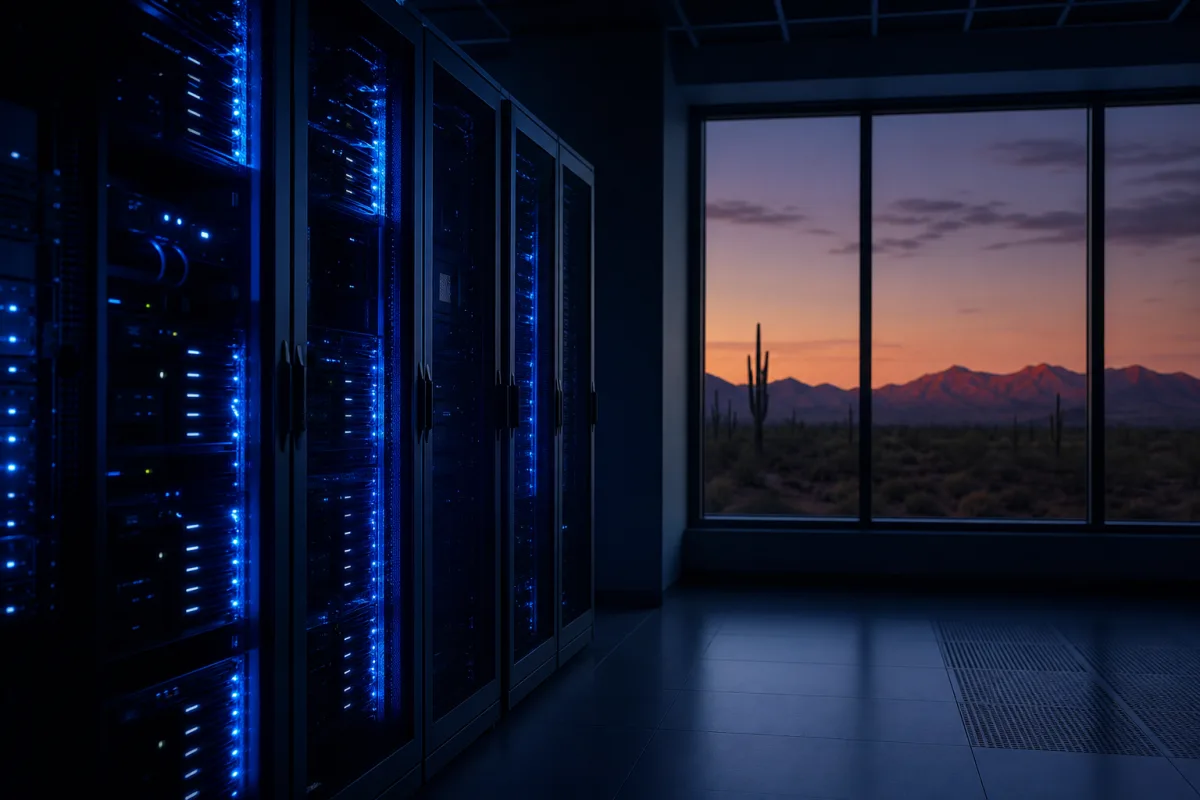
The dry climate is a genuine engineering advantage for evaporative and adiabatic cooling approaches, which can improve effective PUE materially. The counterweight is water, which is a serious regional issue and worth asking every operator about directly.
The design that actually works.
We see Phoenix used both as a primary western site and as the training half of a split with a coastal inference layer. For buyers weighing disaster risk as part of resilience planning, it scores better than most alternatives.
As with everywhere, we qualify on secured power and the cooling design your generation actually needs, not on brochure density. Wider context is on the United States desk, and cooling and power questions on the space and power desk.
Start from what is verified.
Current verified lines with quantities, lead times and indicative pricing are public on the live inventory. Anything not listed becomes a sourcing requirement with a first pass inside one business day.
Colocation in Phoenix, through the same desk.
The desk sources colocation, racks and power in this metro as well as the compute that fills them. Phoenix trades cooling-degree days against cheap land and fast permitting, and the arithmetic keeps working. Requirements come to us as three numbers: megawatts at day one, kilowatts per rack, and the date. The space and power desk takes it from there, and above 40 kW per rack we will tell you honestly how short the local shortlist is.
Asked first, answered straight.
Yes. Space, power and cooling in this metro route through the same desk as the compute, priced against your density and date. Above 40 kW per rack the local shortlist narrows quickly, and we say so rather than tour you through halls that cannot take the load.
Power availability and cost, plus lower natural disaster exposure. California's constraints are severe; Arizona has been able to energise capacity at pace. Latency to the western US remains good.
It is a legitimate regional concern and depends heavily on the cooling design. Some approaches are water-intensive, others much less so. Ask every operator directly and we will help you interpret the answers.
Dry heat suits evaporative and adiabatic cooling better than humid heat, and modern designs handle it well. Effective PUE in well-designed Phoenix facilities is competitive.
Both, though the economics favour it most for sustained training. Many buyers pair Phoenix training capacity with an inference layer closer to their users.
Working through this on a real requirement?
Twenty minutes with the desk, no pitch and no quote at the end of it. Tell us roughly what you need and we will come back within one business day.
Sent. We are on it.
Your enquiry has landed with the desk. Acknowledged within one hour.