
The GPU Buyer's Playbook.
Five pages of the arithmetic buyers usually learn the expensive way: how to size a cluster before you shop, the whole bill before the first quote, why the cheap quote is often the expensive one, honest lead times, and the questions that expose a weak sourcing desk, including us.
On its way, and here now.
Save it, share it, argue with it.
We are compliance first, it's the first thing we'll ask.
我们坚持合规优先,这是我们首先会询问的事项。
Five pages, and the numbers behind each one.
The playbook is built from lines the desk actually transacts, not from a vendor deck. Every figure in it is checkable against the live inventory on this site.
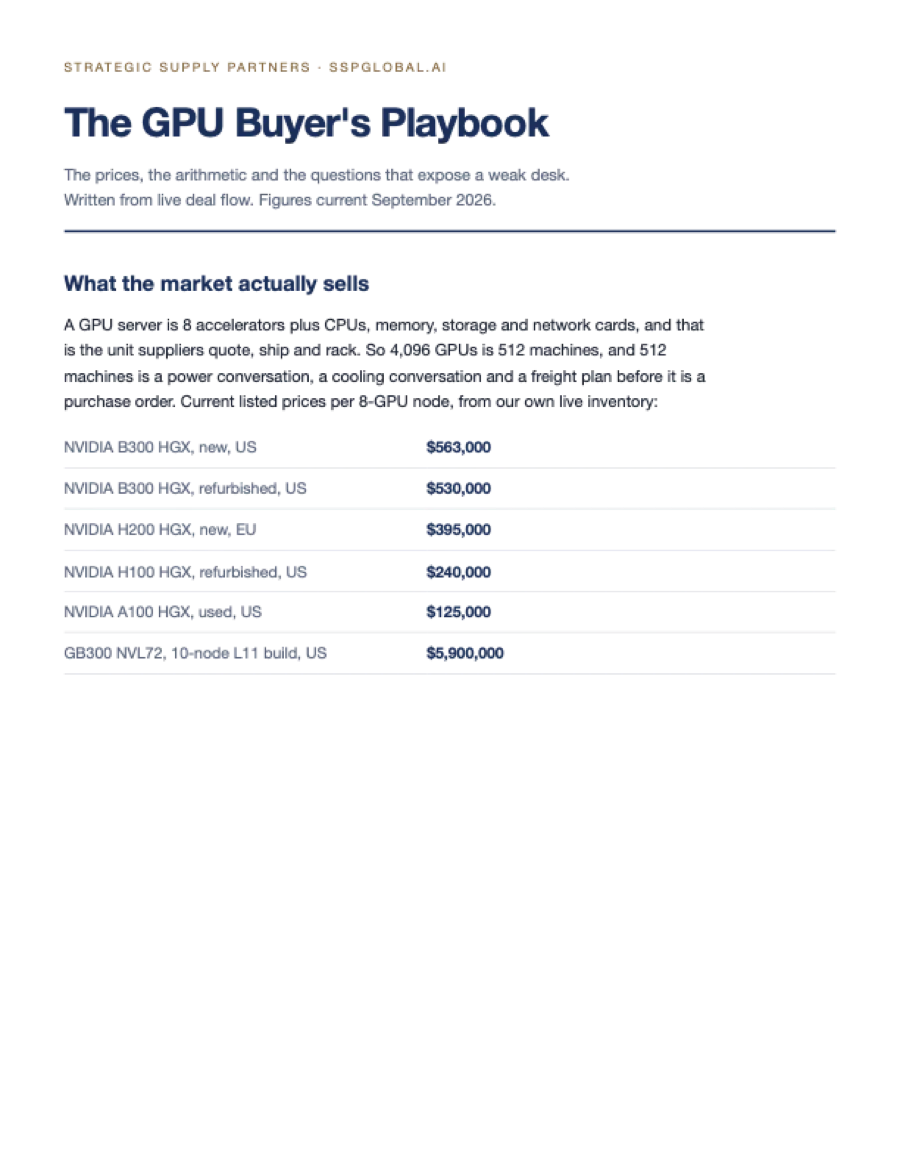
What the market sells. A GPU server is 8 accelerators plus CPUs, memory, storage and network cards, so 4,096 GPUs is 512 machines. Listed prices per node today: B300 at $563,000 new and $530,000 refurbished, H200 at $395,000, H100 at $240,000 refurbished, A100 at $125,000 used, and a GB300 NVL72 10-node build at $5,900,000.
Rent or buy, with the arithmetic shown. A 3-year term is 26,280 hours. At $4.00 per GPU-hour that is $840,960 for one 8-GPU node. Buying the same node is $563,000, and once colocation at roughly $196 per kW per month and about $16,000 of optics are added, owning lands at $677,784. The playbook shows where that flips.
The bill beyond the accelerator. Fabric and optics, power and cooling, storage fast enough to keep the GPUs fed, freight, duties and commissioning. Each looks small beside the GPU line and together they carry most of the schedule risk.
Landed cost, not ex-works. What sits between the factory door and your rack, and why two quotes 10% apart can invert once the border is counted.
Six questions that expose any desk, including this one. Who pays you, show me a line you turned down, what is my priority when capacity tightens, is this landed or ex-works, who do I contract with, and what happens at the end of the term.