
From nice-to-have to gate
Five years ago data residency was a preference in most deals. Today, for government, finance, health and anyone serving them, it is a gate: regulation and policy decide which workloads may leave the country, and increasingly which buildings and operators are acceptable even inside it.
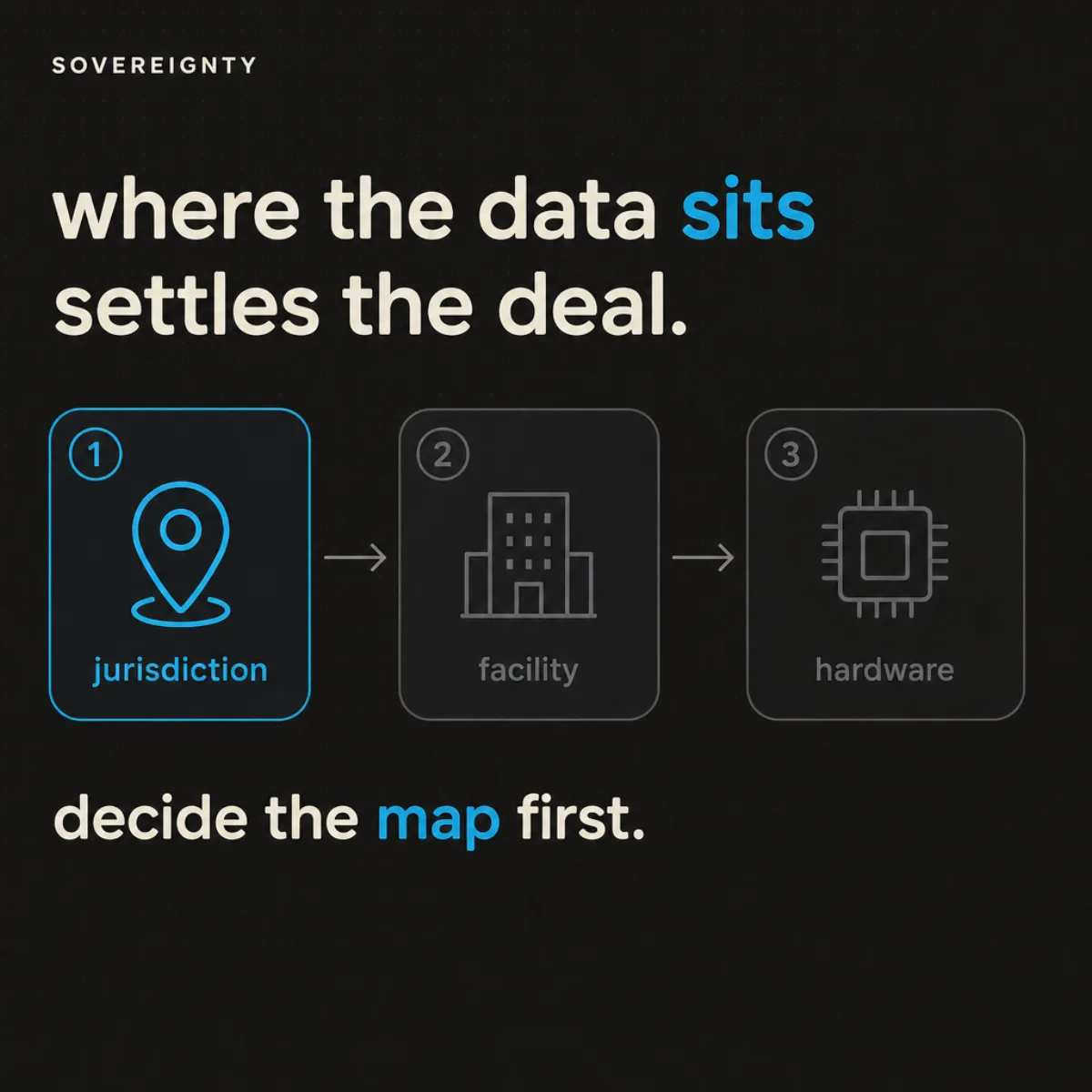
The practical shift is in sequencing. In a residency-bound deal, jurisdiction comes first, facility second, hardware last. Run it the other way, pick the hardware and then discover the residency constraint, and you will run the procurement twice. I have watched it happen to teams who did everything else right.
What sovereignty actually specifies
"Sovereign" gets used loosely, so in deals I break it into questions with checkable answers:
- Where does the data physically sit? A country is not an answer; a named facility is. Ownership, staffing and access controls of that facility are part of the answer.
- Under whose law? The jurisdiction of the facility, the operator and the corporate chain above it. Foreign ownership of a local building matters to some frameworks and not others; you need to know which yours is.
- Who can touch it? Cleared-personnel requirements, operator-of-choice rights, audit access. These narrow the facility list dramatically, which is precisely why they must come early.
- What can leave? Almost no workload is uniformly sovereign. Splitting the regulated layer from the exportable layer, and placing each where it belongs, is usually the difference between an affordable design and a gold-plated one.
Sovereignty is a design input, not a compliance checkbox. Decide the map first and the rest of the deal follows; decide it last and you do the deal twice.
The split-stack pattern
The design I see work repeatedly: the regulated data layer in a named in-country facility that satisfies the framework, the heavy training or exportable inference placed wherever capacity is best, and private connectivity between the two. Regulators get the residency they require; the budget gets world-market economics on everything the rules do not bind. It takes more thought than putting everything one place, and it is almost always worth it.
One warning
Beware sovereignty theatre: capacity marketed as sovereign where the paper trail does not survive inspection. If a provider cannot name the building, the operator and the ownership chain in writing, the word on the brochure does not matter. In this segment, verifiability is the product.
Three questions before any procurement starts
For a regulated buyer, the pre-work is three questions, answered in writing before anyone prices hardware. Which frameworks actually bind this workload, and what do they literally require, as opposed to what the compliance folklore says they require? The gap between those two is frequently enormous, and gold-plating to folklore is how sovereign projects triple their budgets. Second, which layers of the workload carry the binding data, and which are genuinely free to run anywhere? The split-stack answer falls straight out of an honest data map. Third, who inside the organisation can accept residual risk, and at what level? Sovereignty decisions stall for months when nobody knows who is allowed to say yes.
With those three answered, the procurement is almost mechanical: the facility list filters itself, the split architecture designs itself, and the deal moves at commercial speed because the constraint work is already done. Without them, every option evaluation reopens the same arguments, and the project ages in committee while the hardware market moves on.
The pattern I keep seeing: teams treat sovereignty as a reason to move slowly. Done in the right order, it is the opposite: the constraints are decided once, early, and everything after moves faster because the map is settled.