
The headline number
Where the money actually sits
- A modest fifty-node deployment is a megawatt-class power conversation once cooling overhead is counted, and grid connections are quoted in years in most major markets.Source: Industry capacity reporting, 2026
- Hyperscaler GPU pricing runs about 86% above dedicated providers, a gap that has nothing to do with the silicon and everything to do with the layers around it.Source: Compute Exchange, 2026
- A full GB300 racked build, hardware plus wiring and network integration, prices near $5.9m for ten nodes: the GPUs are only one line of that number.Source: SSP verified inventory, August 2026
GPU pricing gets all the attention because it is the number everyone can compare: dollars per card, dollars per hour. Procurement teams grind on it for weeks and feel the grind was worth it.
Then the cluster gets built, and the rest of the bill arrives. Power and cooling, often the largest operating line over the life of the machine. The fabric and its optics, which at third-party markups can rival the switching itself. Freight, duties and import handling at node weights. Storage fast enough to feed the GPUs you fought so hard to price. Each line smaller than the GPU number; together, frequently bigger.
Why the market keeps it this way
Partly habit: GPUs are the scarce, glamorous input, so they anchor every conversation. But partly structure: sellers benefit from a market where buyers compare one number. A quote that wins on GPU rate and quietly recovers margin on optics, integration and freight is not an accident; it is a business model, and it works on any buyer comparing headlines.
This is exactly why comparing ex-works quotes is comparing fiction. The only honest comparison between two offers is the landed, running, connected cost.
Never compare GPU rates. Compare the total cost of a running cluster: hardware, power, cooling, fabric and the border, on one sheet.
Reading the whole bill
- Power and cooling: ask for the rate, the escalation terms and the density the floor genuinely supports. A cheap hall that cannot cool your generation is not cheap.
- The network: price the fabric with the cluster: switches, transceivers, cabling. If a quote leaves it out, that is the margin's hiding place.
- The border: freight, insurance, duties, import handling and recovery. On international deals this line alone can swing supplier comparisons.
- The exit: what the hardware is worth when the generation turns, and who buys it back. A residual priced at signature is money most buyers leave on the table.
The door and the room
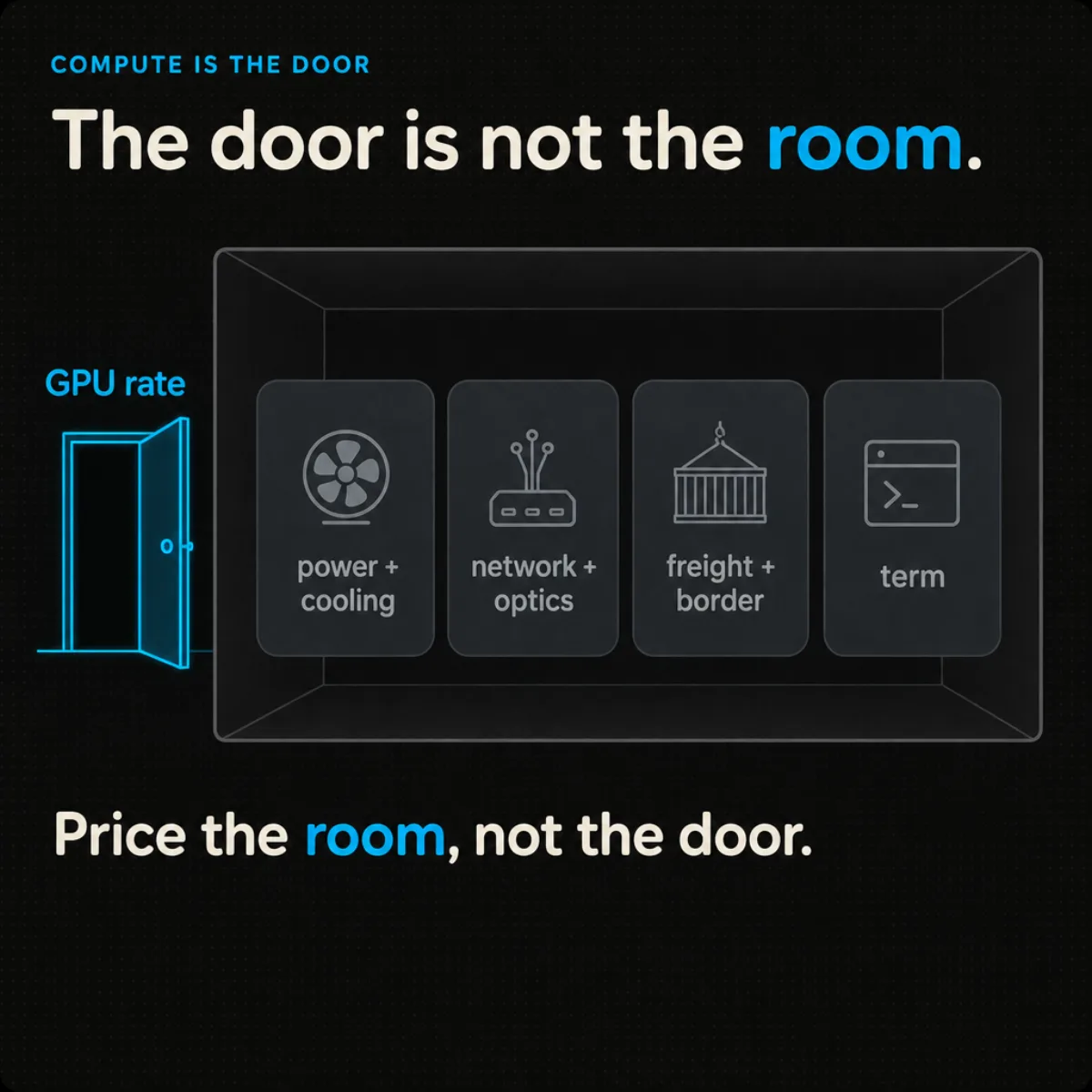
I think of the GPU rate as the door: you have to get through it, but nobody lives in a doorway. The room behind it, power, cooling, network, logistics, term, is where the money actually lives. Buyers who walk in with a plan for the room do dramatically better than buyers who spent everything winning the door.
A budget that survives contact
The version of this that works in practice is a one-page bill built before the first quote is requested, with a line for everything the cluster will actually consume: nodes, fabric and optics, storage, facility power and cooling at the real density, freight and border, integration and commissioning, and the term structure carrying it all. Fill in rough numbers, even bad ones. The point is not precision; the point is that no line can ambush you later, because every line already exists.
Then, when quotes arrive, they get normalised onto that sheet rather than compared to each other. A quote that looks sharp but leaves four lines blank stops being sharp the moment the blanks get filled with market numbers. This is also, not coincidentally, how you spot the seller whose margin lives in the lines they left off; they are always the ones most resistant to the exercise.
The discipline sounds obvious written down. Almost nobody does it, because the GPU number arrives first and anchors everything. Refuse the anchor, price the room instead of the door, and you will make better decisions than most of the market by Tuesday.