
The build is real
The Australian picture in numbers
- Sharon AI announced a six-year collaboration with NVIDIA covering up to 40,000 Grace Blackwell GB300 GPUs and 72 megawatts of new Australian data-centre capacity.Source: Barchart, Sharon AI and World Wide Technology announcement, 2026
- Australia's position as an AUKUS partner and a destination outside China-focused licence requirements is attracting hyperscaler and vendor investment, including from NVIDIA.Source: Gilbert + Tobin, AI infrastructure and financing, 2026
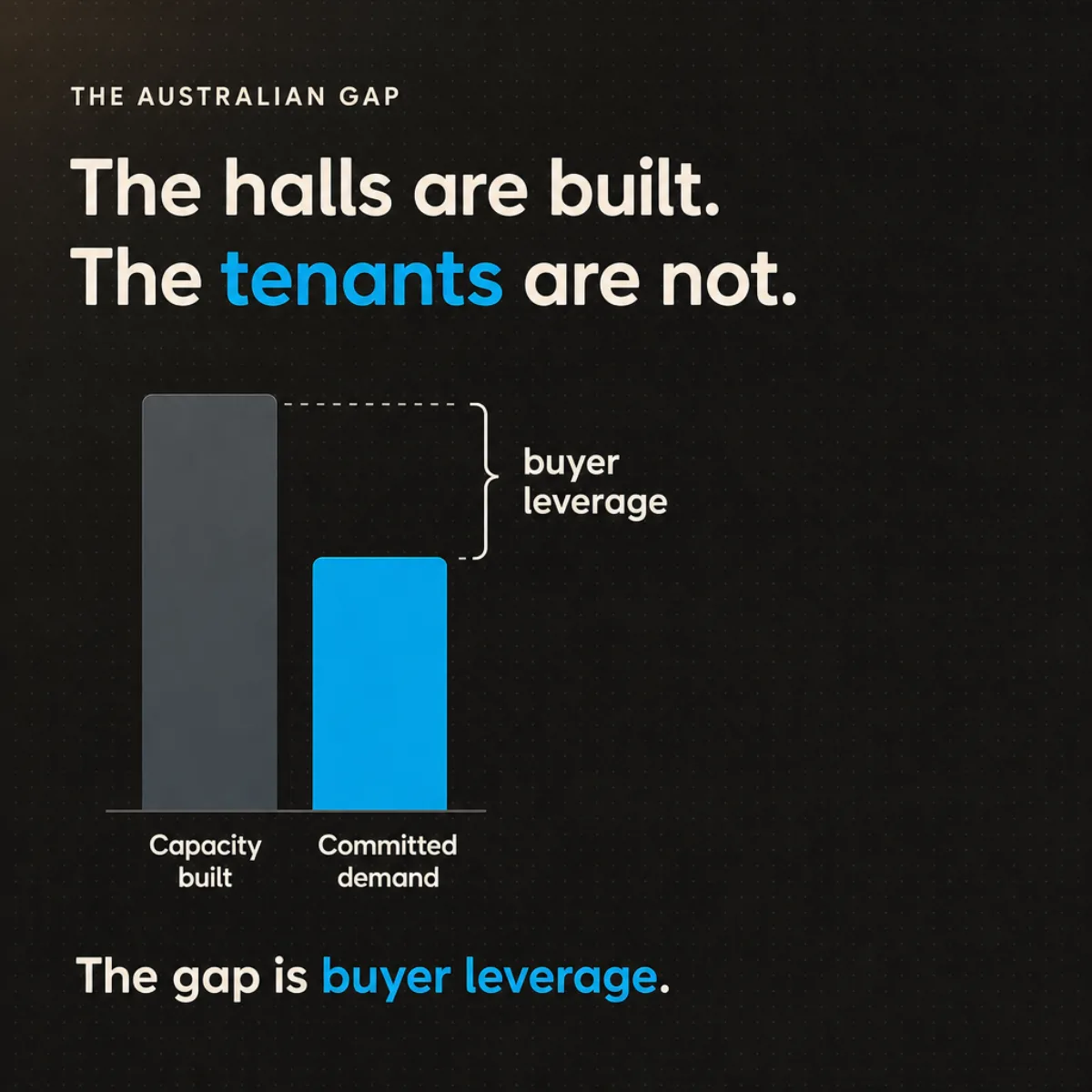
- Against that build, committed local off-take remains the scarce side of the equation, which is where buyer leverage currently sits.Source: SSP desk observation, August 2026
Walk the announcements and Australia looks like a boom market: hyperscale campuses across Sydney and Melbourne, gigawatt-class pipelines, sovereign AI programmes, and global operators treating the country as a priority destination. As a trusted US ally with favourable treatment under American chip export policy, Australia gets access that much of the region does not. The halls are going up.
What I see from inside deals is the other half of the picture: the capacity is arriving faster than committed local demand. Operators are building ahead of off-take, betting the tenants come. Some of that is rational land-grab economics. Some of it is going to be very available capacity looking for a workload.
Why demand lags
Australian enterprise AI spending is growing, but the units are wrong. A hall is leased in megawatts and multi-year terms; most Australian buyers are still purchasing in projects and quarters. Between the two sits a translation problem almost nobody owns: turning "we need AI capability" into a signed commitment for space, power and hardware that a board will carry.
The gold-rush pattern is worth remembering: the people selling picks and shovels did well, but so did whoever matched miners to claims. Right now Australia has more halls than miners, and matching is the scarce skill.
In Australia the constraint has flipped: capacity is outrunning committed demand. That is bad news for operators without tenants and quietly excellent news for buyers who know it.
What this means if you are buying
- You have more leverage than the market tone suggests. Operators with floors to fill negotiate differently from operators with waiting lists. Terms, ramp schedules and expansion rights are all softer than the headlines imply, if you ask.
- Local hosting is genuinely on the table. For residency-bound workloads, the capacity to keep things onshore exists now in a way it did not two years ago.
- The hardware still lands from offshore. Every GPU in every Australian hall arrived through an import process, which means landed cost and lead time are part of every deal whether the seller mentions them or not.
And if you are holding capacity
The same gap runs the other way: if you have built or committed to capacity you cannot fill, the problem is not your facility, it is your route to qualified demand. That matching problem is solvable, but not by waiting.
How to actually use the gap
If I were buying Australian capacity this quarter, here is the sequence I would run. First, write the requirement in the operator's units before approaching anyone: megawatts or racks, density, term, live date. The buyer who arrives speaking hall-language gets treated as a tenant; the one who arrives with a project brief gets treated as a lead. Second, ask every operator one uncomfortable question: how much of this campus is committed today? You will not always get a straight answer, but the hesitation is data, and it prices the negotiation. Third, get the concessions that cost an empty hall nothing but will cost you dearly later: expansion rights in writing, ramp schedules that match your growth rather than their revenue plan, and exit terms priced now.
And if the residency rules do not bind your workload, run the offshore comparison anyway. US and EU capacity at current availability often beats local pricing by enough to fund the latency workaround, and knowing that number, even if you stay onshore, changes what onshore costs you. The operators know their competition is global. Buyers should negotiate like they know it too.