
GPU capacity in Amsterdam.
Amsterdam trades on connectivity: one of the world's great internet exchanges, dense carrier presence and subsea landings. What it cannot trade on is unconstrained growth.
What decides a deployment in this metro.
Why buyers come here, and what they run into.
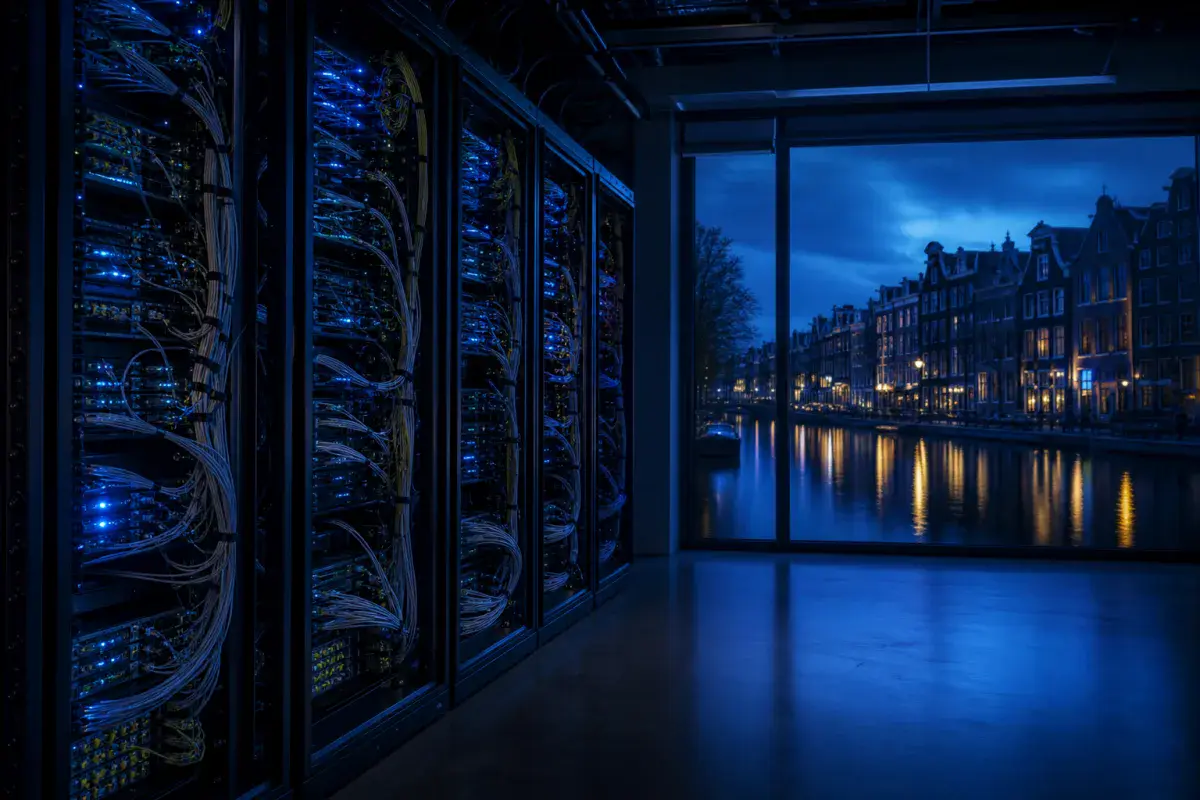
The Amsterdam metro is a genuine European front door: exchange density, carrier choice and subsea cable positions that make it a natural landing point for traffic entering the continent. For inference serving European users, the latency case is straightforward.
Growth, however, has been actively managed. Planning restrictions around the region have periodically slowed new hyperscale development, pushing serious capacity to the periphery and beyond. Buyers arriving with an assumption of availability are usually recalibrating quickly.
The design that actually works.
The workable design is the familiar one: latency-sensitive layer in or near Amsterdam, sustained training where power is available and cheaper, connected privately. As an EU market both legs move without a customs event on EU-located hardware.
We qualify facilities on secured power and the cooling your generation needs rather than on advertised density. Wider context is on the Netherlands desk, and inter-site links on the networking desk.
Start from what is verified.
Current verified lines with quantities, lead times and indicative pricing are public on the live inventory. Anything not listed becomes a sourcing requirement with a first pass inside one business day.
Colocation in Amsterdam, through the same desk.
The desk sources colocation, racks and power in this metro as well as the compute that fills them. Amsterdam operates under some of the tightest municipal restrictions in Europe, so genuinely available halls change quarter to quarter. Requirements come to us as three numbers: megawatts at day one, kilowatts per rack, and the date. The space and power desk takes it from there, and above 40 kW per rack we will tell you honestly how short the local shortlist is.
Asked first, answered straight.
Yes. Space, power and cooling in this metro route through the same desk as the compute, priced against your density and date. Above 40 kW per rack the local shortlist narrows quickly, and we say so rather than tour you through halls that cannot take the load.
Local planning policy has periodically restricted new hyperscale development around the region. Connectivity stayed excellent; new floor space became harder to secure.
Usually not, unless residency requires it. Its value is interconnection, which training does not need. Training capacity prices better elsewhere in Europe.
Landings and exchange density make Amsterdam a natural entry point for traffic into Europe, which matters for latency-sensitive serving rather than for batch training.
Not for EU-located hardware. That removes clearance from the critical path and shortens lead times to days.
Working through this on a real requirement?
Twenty minutes with the desk, no pitch and no quote at the end of it. Tell us roughly what you need and we will come back within one business day.
Sent. We are on it.
Your enquiry has landed with the desk. Acknowledged within one hour.